iPhone 14 OLED vs iPhone 12 OLED — What Actually Changed, and Why It Matters When You're Replacing Screens
When repair shops talk about OLED iPhones as if they're all broadly similar, I understand why - from the outside, an iPhone 12 and an iPhone 14 both have flat OLED screens that look excellent. But from a supply and repair standpoint, these are meaningfully different display assemblies, and the differences matter in ways that a lot of technicians don't discover until something goes wrong.This isn't a theoretical comparison. The specific issues I'm going to describe here are things we've seen in warranty returns, things that suppliers have called us about when a batch generated unexpected failures, and things I've personally traced back to mismatches between screen grade and phone model. If you're buying OLED replacement screens for iPhone 12 through 14, read this before your next order.
The display hardware differences, model by model
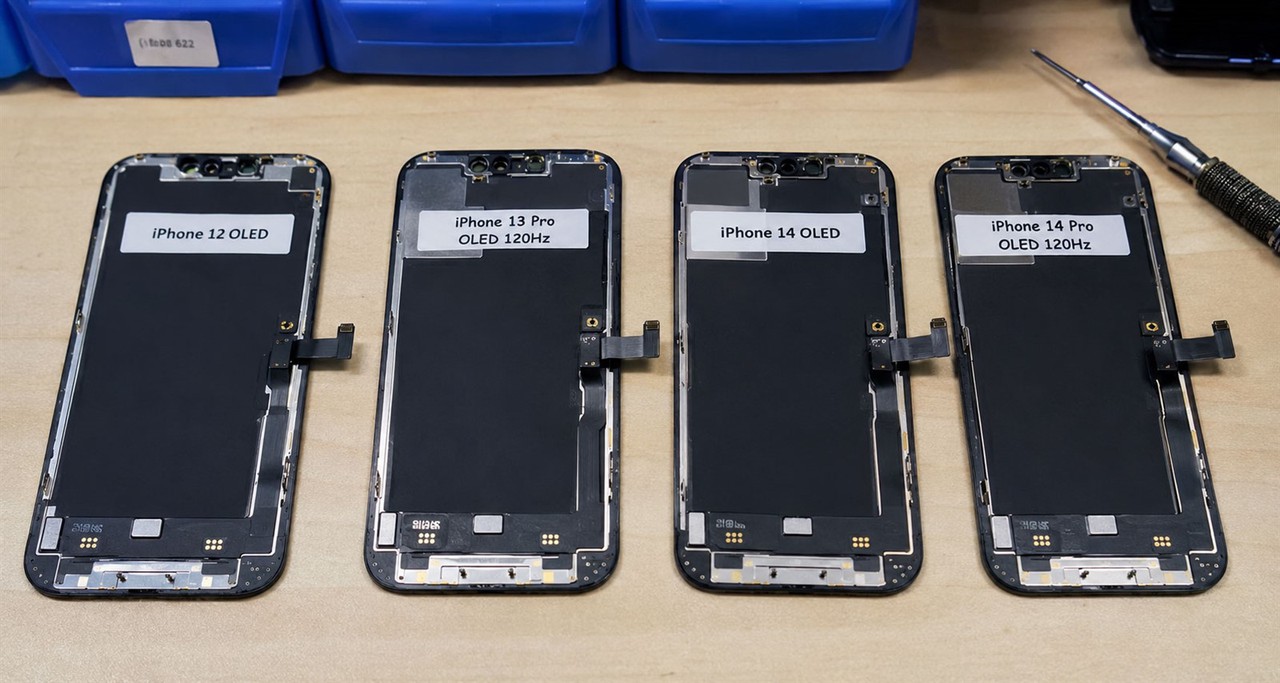
iPhone 12 and 12 Pro (2020): Both use Super Retina XDR OLED panels - Apple's first flat OLED iPhones after the curved-edge XS series. The display controller on the 12 Pro runs at a fixed 60Hz. The panel itself is sourced from Samsung Display (OLED) in Apple's own supply chain. The FPCB routing on the 12 is the most forgiving of the modern OLED lineup to work with - the connector position and flex angle are relatively accommodating. First-generation aftermarket panels for this model are now mature and quality has settled considerably.
iPhone 12 Pro Max (2020): Larger panel, different backlight structure, and - critically - a different display connector pinout than the standard 12 and 12 Pro. This is a mistake we see regularly: technicians who order generic "iPhone 12 OLED" replacements receive standard 12 panels and attempt to fit them to a Pro Max. The screens will not fit and will not function. The Pro Max is a separate SKU - always order specifically.
iPhone 13 and 13 Pro (2021): The 13 Pro and Pro Max introduced ProMotion - 120Hz adaptive refresh rate. This is where the replacement supply chain gets significantly more complicated. True ProMotion requires the display driver IC to communicate with the panel at variable refresh rates between 1Hz and 120Hz. Aftermarket panels for the 13 Pro that use a standard 60Hz OLED panel but a ProMotion-capable FPCB will appear to function correctly on a bench test - the screen lights up, touch works - but will default to 60Hz operation, and iOS will often display the "Unknown Part" warning. For a repair shop marketing premium services, this is a meaningful quality difference that customers with 120Hz expectations will notice.
iPhone 14 (2022): The standard iPhone 14 uses a 60Hz OLED - the same basic refresh rate as the 12 and 13. However, the display assembly on the 14 has a different FPCB length and routing path to accommodate the internal layout changes Apple made with the 14's redesigned chassis. An iPhone 13 OLED panel, even if the connector is physically compatible, cannot simply be swapped into a 14 chassis. The cable routing will be wrong and applying pressure to close the phone will stress the flex in a way that causes connector failure within weeks.
iPhone 14 Pro and Pro Max (2022): These introduced the Dynamic Island and the always-on display - both of which require specific display driver behaviour that aftermarket panels currently cannot replicate. The always-on display in particular relies on LTPO (Low Temperature Polycrystalline Oxide) backplane technology that allows the panel to refresh at 1Hz. No current aftermarket OLED panel for these models supports LTPO. When you fit an aftermarket screen to a 14 Pro, always-on display will be disabled, and the phone will flag it in Settings. This is expected behaviour with current aftermarket supply - it's important to communicate this to repair shop clients clearly, so they communicate it to their customers before the repair, not after.
The backlight circuit difference that can damage a logic board
This is the section I most want technicians to read carefully, because the consequences here are not just cosmetic.
Apple made changes to the OLED backlight driver circuit between the iPhone 12 generation and the iPhone 13/14 generation. Specifically, the current supplied to the OLED panel's backlight driver on the logic board was adjusted upward to support the brighter peak brightness targets on the 13 and 14 Pro models (1200 nits peak on 13 Pro vs 800 nits on 12 Pro).
If you install an iPhone 12 OLED panel into an iPhone 13 or 14 chassis - either because a supplier sent the wrong model, or because a technician used a "compatible" screen without confirming the generation - the 12-generation panel's backlight driver IC will receive higher current than it was designed for. In most cases this results in gradual backlight IC degradation, showing up as dimming or uneven brightness within four to eight weeks. In a smaller number of cases - particularly if the phone is used at high brightness in a warm environment - it results in backlight IC failure: the screen goes dark, the touch layer continues to function, and the repair appears to have caused a new fault.
We've traced this failure mode in returned units three times in the past two years. In each case, a batch of iPhone 12 screens had been labelled and sold as compatible with iPhone 13. The screens physically fitted. They passed bench tests. The failure showed up at the six-week mark.
The rule is simple: always verify the exact model generation at the point of order, not just the form factor. "iPhone 12/13 OLED compatible" is not a specification - it's a red flag.
What to confirm before ordering OLED replacement screens?
Model-specific FPCB routing: The flex cable length and routing path differs between models. Confirm the screen is built specifically for the model you're repairing - not just for the product family.
Refresh rate capability: For 13 Pro and 14 Pro models, confirm whether the replacement screen supports ProMotion or defaults to 60Hz. This should be stated explicitly on the product listing. If it isn't, ask before ordering.
Backlight driver compatibility: Any supplier worth dealing with should be able to confirm whether their panel's backlight driver is matched to the target model's logic board circuit spec. If they can't answer this question, the screens have not been engineered for the specific model - they've been adapted from a different model and may carry the failure risk described above.
Always-on display behaviour on 14 Pro: Confirm upfront that this feature will be disabled on any current aftermarket screen. This is normal for current aftermarket supply, but it needs to be stated clearly.
True Tone and Face ID behaviour: True Tone will not function on any aftermarket OLED panel. Face ID is not affected by the display assembly - it's handled by the TrueDepth camera system independently of the screen. These two are consistently confused by both technicians and customers, and getting ahead of the confusion is faster than resolving it after the repair.
Why quality variation is higher for newer OLED models?
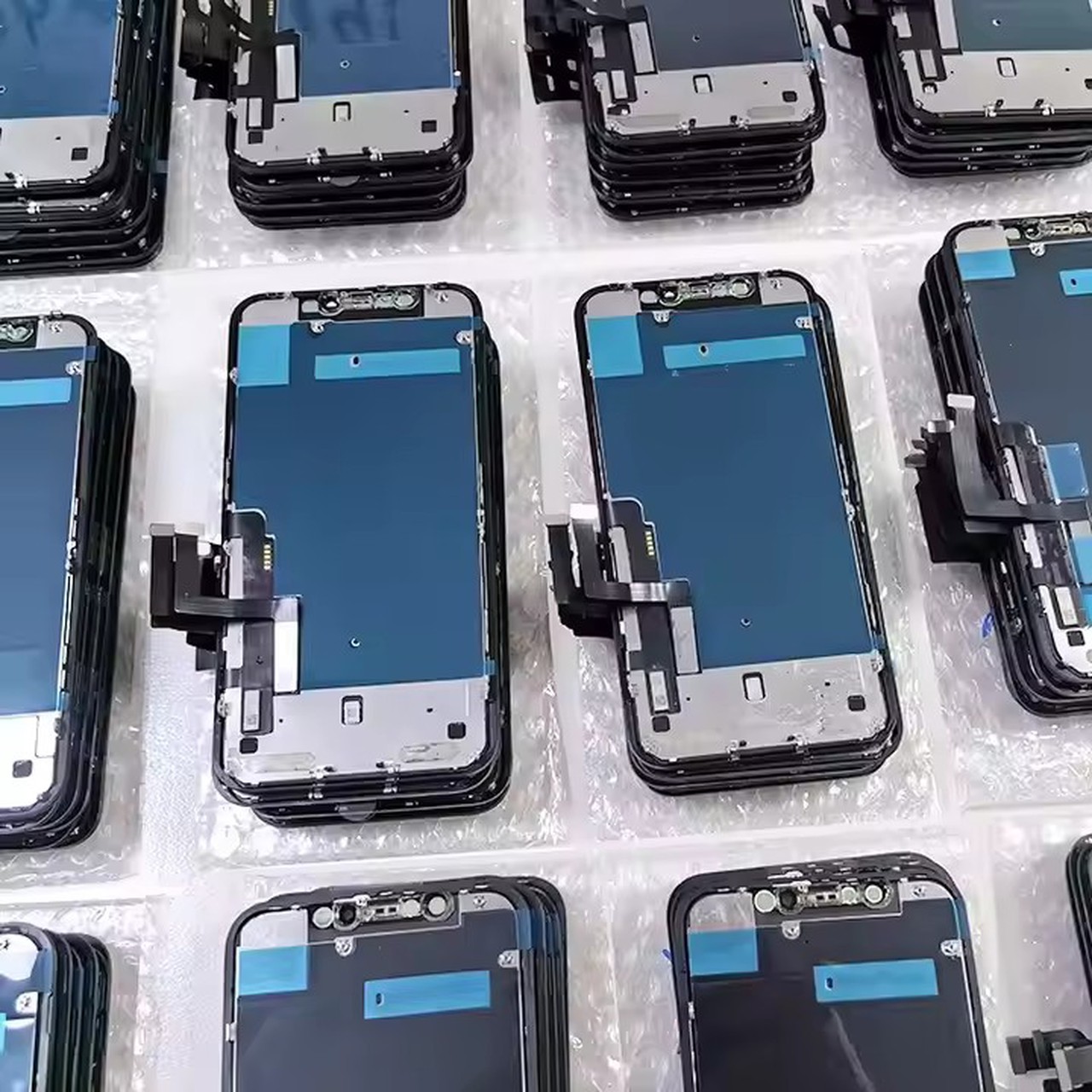
For iPhone 12, the aftermarket OLED supply has had four years to mature. Panel quality is relatively consistent, the failure modes are well understood, and the supply of OEM-pull panels is healthy. For iPhone 14 Pro, the aftermarket is still relatively early-stage - the supply of pulled original panels is limited, and the aftermarket panel technology for ProMotion and always-on support is still catching up. This means quality variance is higher, and the risk of receiving panels that have been misclassified or adapted from a different model is meaningfully greater.
When sourcing OLED screens for 13 Pro, 14, and 14 Pro models specifically: order smaller initial quantities from any new supplier until you've validated the batch with a real-world installation and a two-week test period. The cost of a larger cautious order is much lower than the cost of a batch of logic board failures.